Douglas Funke

Pondering

Relativity

AN ILLUSTRATED GUIDE FOR BUILDING AN UNDERSTANDING OF EINSTEIN'S RELATIVITY

When first introduced by physicist Albert Einstein in 1905 and later expanded in 1915, the theories of relativity were controversial and not universally accepted. Since then, many scientific studies have confirmed the theories’ predictions. Today, relativity is central to our understanding of the Universe.

Douglas Funke

Douglas Funke is a Certified Professional Ergonomist (CPE) and human factors engineer with more than 30 years of experience in research, development, and technology-driven industries. He holds a Master of Science degree in Industrial Engineering with a concentration in Human Factors and Ergonomics.
Throughout his career, Doug served as a Principal Human Factors Engineer for several research and development organizations, where he specialized in making complex systems and technologies more intuitive, accessible, and user-friendly.

EXPERIENCE THE STORY

Watch The Official Book Trailer

Discover the inspiration behind Pondering Relativity through the official trailer. Experience the ideas, discoveries, and scientific journey before exploring the complete book.

  • Official Book Trailer
  • Learn Einstein's Relativity in a Simple Way
  • Watch Directly on the Website
OFFICIAL TRAILER
Book Trailer
About the Book
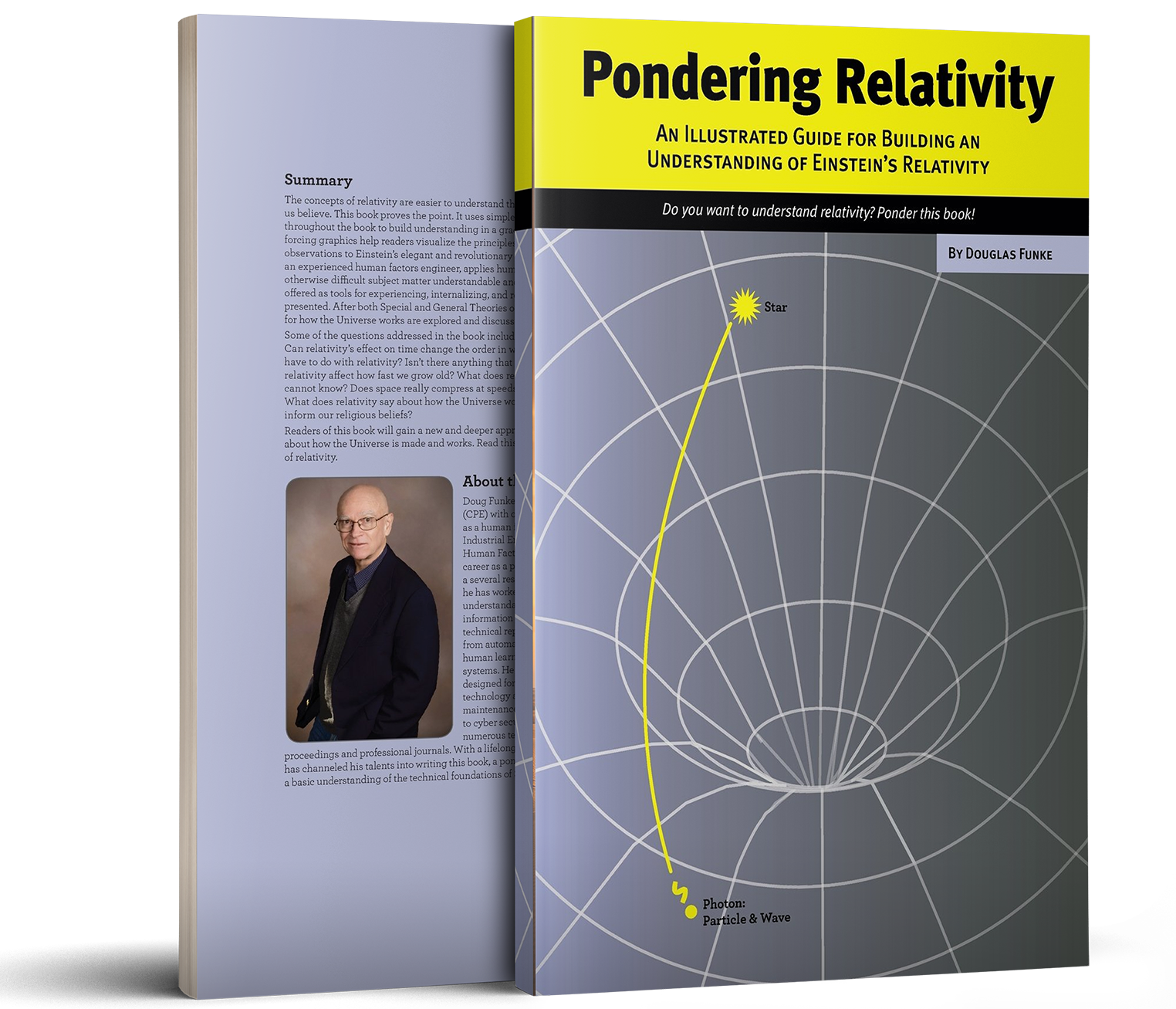
Pondering Relativity

This book describes relativity in the simplest of terms with illustrations to help visualize and understand its principles.

This book was motivated by my lifelong interest in astronomy, physics and science, together with my love of writing and passion for making things understandable. I have over 30 years experience working as a human factors engineer at several research engineering companies. Throughout this time a major part of my job was to communicate technical information clearly.

ALL CHAPTERS

BOOK CHAPTERS

Chapter

01

When first introduced by physicist Albert Einstein in 1905 and later expanded in 1915 the theories of relativity were controversial and not universally accepted. Since then, many scientific studies have confirmed the theories’ predictions. Today, relativity is central to our understanding of the Universe.

Chapter

02

The nature of light and how we experience and measure it are funda- mental to understanding the theory of relativity. This chapter describes light and builds this foundation, which also provides important insights into the size of the Universe.

Chapter

03

Before Einstein, many scientists believed there was an invisible structure that defi ned space called the aether. It was believed that, once found, the aether would serve as a common reference for measuring all motion. It was also believed that the aether, represented as a grid in this illustration, was the medium through which light waves traveled. Today, we know that there is no aether defi ning space.

Chapter

04

The speed of light is measured within a train car. This is done using a special (imaginary) stopwatch capable of measuring extremely short periods of time. The scientist measures the speed of the photon as it goes from the light bulb on the ceiling to the mirror on the fl oor and back to the ceiling. As expected, the photon is found to be traveling at speed “c.”

Chapter

05

A light-clock can illustrate time slowing on a moving object. This fi gure shows the use of a light-clock to illustrate the Special Relativity effects of a rocket ship moving rela- tive to Earth. The stopwatch and space compression graphics are used to remind us that time is slowed and space compressed (shorter light path) on moving platforms.

Chapter

06

How high-speed travel affects the passage of time for the “moving” rocket ship. In this illustration the rocket ship is moving at &%! of the speed of light relative to the Earth and star. Because the Earth / star is the “stationary” frame-of-reference the elapsed time on the moving rocket ship is less as measured from the Earth

Chapter

07

Is the bucket spinning, or is the Universe spinning around the bucket? Could a “spinning” bucket just as easily be considered to be stationary with the Universe spinning around it in the opposite direction? If it is the Universe spinning around the bucket, then to explain the centrifugal forces experienced, Einstein concluded that motions involving accel- erations are different from uniform motion and cannot be described by Special Relativity. He developed General Relativity to explain the centrifugal forces.

Chapter

08

Adding dimensions affects geometry in unexpected ways. Going from two to three dimensions creates geometric anomalies that cannot be easily predicted or understood when only considering two dimensions. This is similar to going from our accustomed three-di- mensional space to four-dimensional space-time.

Chapter

09

Einstein’s twin paradox. According to Einstein’s “twin paradox,” two twins are separated at birth. One twin is accelerated to near the speed of light and travels to a nearby star, turns around, and returns back to Earth. Einstein showed that the twin that traveled to the distant star would age less due to the accelerations and high-speed relative motion experi- enced

Chapter

10

Einstein’s theories have profound implications about how we understand the Universe. This chapter continues the discussion of important areas where our understanding of the Universe has been shaped and changed by Einstein’s theories of relativity.

Chapter

11

When Einstein first proposed his relativity hypotheses, they represented a very new way of looking at the Universe, and met with initial skepticism and even some resistance. At the time, it was difficult to verify his ideas experimentally and so they were not immediately accepted. Eventually, exper- iments were conducted and scientific evidence was developed that supported his ideas.

Chapter

12

Einstein offered a new way of understanding the Universe that now stands as the foundation for much of physics. His work illustrates science at its best. It also raises questions, as he did, about the relation between science and religion. This chapter discusses these issues.

WATCH & LEARN

YouTube Video Library

Explore Douglas Funke's educational videos explaining the concepts of Special Relativity and General Relativity in a simple and easy-to-understand way.

Relativity Illustrated

Relativity Illustrated

Special Relativity

Special Relativity

General Relativity

General Relativity

×
TESTIMONIAL

WHAT THEY SAY ABOUT US?

Margaret A. Saleh

Reviewer

“I seriously felt smarter with every page I turned. Physics always alluded me. This book is well organized, and explains the Theory of Relativity (and MANY related forces) in a manner that allows the non-scientist to digest and understand.”

★★★★★
TESTIMONIAL

WHAT THEY SAY ABOUT US?

JP Freniere

Reviewer

“I’m no math scholar, and algebra is what I remember from school and still use… but that’s all I needed. I recommend this book to anyone who wants to actually understand what relativity is all about!”

★★★★★
TESTIMONIAL

WHAT THEY SAY ABOUT US?

Louise Bacon

Reviewer

When I went to high school in the early 1940s, the theory of relativity was never mentioned. The big news those days was they had proved that atoms really did exist. Now, at over 90 years old, I am enjoying, and understanding relativity with only high school math to help me. This book has opened up an understanding of what future explorers will have to know to explore space. This is an easy to read and comprehend explanation of Einstein’s theories.

★★★★★
About the Book
Pondering Relativity

An Illustrated Guide for Building an Understanding of Einstein’s Relativity

This book was motivated by my lifelong interest in astronomy, physics and science, together with my love of writing and passion for making things understandable. I have over 30 years experience working as a human factors engineer at several research engineering companies.